
Perplexity: how surprising each word is
Perplexity measures how well a language model can predict the next word. AI-generated text tends to have low perplexity, because the model that wrote it picked likely words. Human writing usually has higher perplexity: unusual word choices, idioms, a joke, a typo.
This is also the main weakness. Simple, formal or textbook-style human writing can have low perplexity too, and it gets flagged for the same reason.
Burstiness: how much the rhythm changes
Burstiness looks at variation across a document. People write a long sentence, then a short one. They follow a dense paragraph with a light one. Models tend to keep a steady rhythm.
Detectors combine both measures. Text with low perplexity and low burstiness looks most machine-like.
Try it on your own text
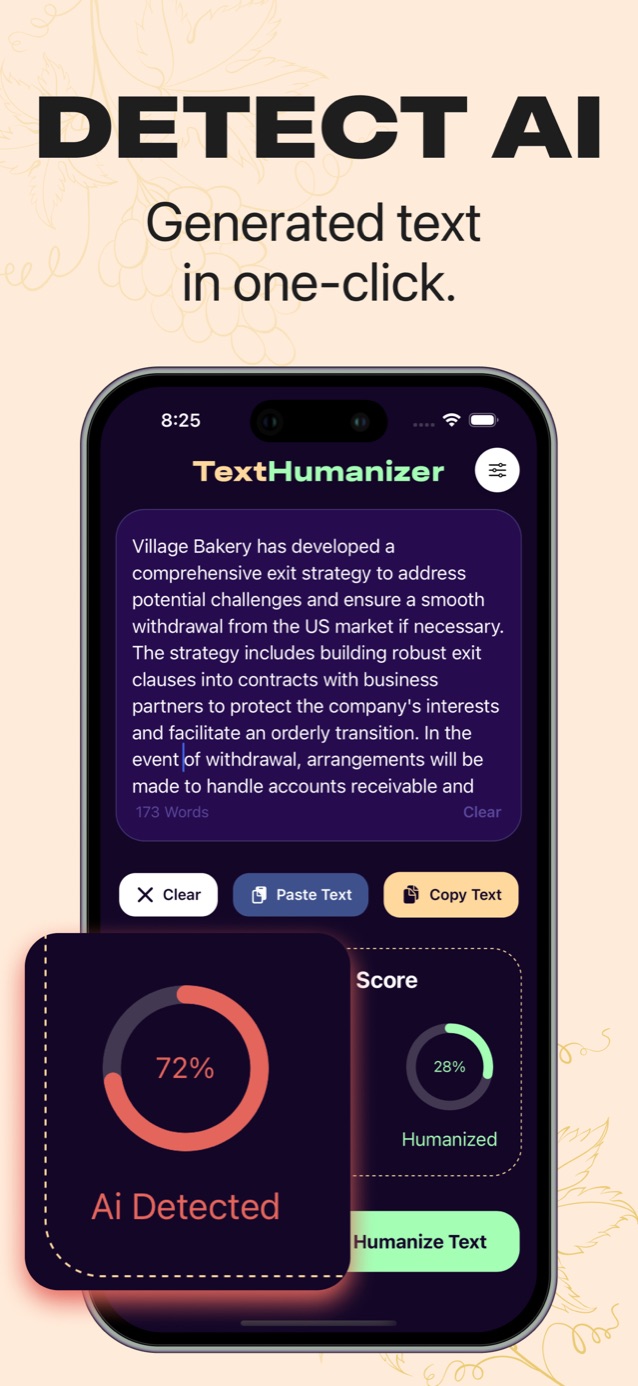
Paste a paragraph and see your AI score before and after.
Check any paragraph for AI in one tap.
Download on the App StoreClassifiers trained on examples
Most commercial detectors, including Turnitin, GPTZero and Copyleaks, go further and train a classifier on large sets of labelled human and AI writing. The classifier learns patterns beyond perplexity, such as favourite phrases and paragraph structure.
That makes them better on the kinds of text they were trained on and worse on anything different: new models, other languages, technical writing or writing by people working in a second language.
Why AI detectors are unreliable
Detection is a moving target. Each new model writes differently, and detectors have to catch up. Editing also blurs the signal: once a person rewrites part of an AI draft, the text is genuinely mixed.
False positives are the bigger problem. A 2023 Stanford study found that seven detectors misclassified over half of a set of TOEFL essays by non-native English speakers as AI-written. A 2026 preprint analysing more than 135,000 document pairs found false-positive rates ranging from 0% to 100% across 13 detectors.
Using an AI checker sensibly
A detector score is most useful as a pointer: it tells you which passages read as predictable. TextHumanizer's Check for AI gives you that score for any paragraph, and Humanize Text rewrites the flat parts so you can compare before and after.
Questions
Can AI detectors detect every AI model?
No. They are trained on output from specific models and lag behind new releases. Accuracy also drops for languages and writing styles that were rare in their training data.
Do AI detectors store my text?
It depends on the tool. Some keep submissions to improve their models, so check the privacy policy of any detector before pasting sensitive work.